Electrical injury
The Hanging GirlElectrical injury becomes the immediate physical consequence of Pirjo’s attempt to torture Carl Mørck and Assad with the Academy’s solar equipment. The current is not a fixed threat: its force depends on the sunlight, turning the control room’s wiring into a mechanism whose danger can rise as the clouds thin. Assad’s burned thumb becomes the means of interrupting that circuit, leaving him gravely injured but helping the two men survive.
The Solar Circuit and Initial Injury
Pirjo prepares the men while they are bound together and alone in the room. As the immigrant begins to regain consciousness, she cuts two three-metre lengths of cable, winds one around his thumb and the other around Carl’s left ankle, then opens the junction box where the solar-system cables meet. Shirley and an electrician had unknowingly shown her how to use the equipment for torture: in weak sun the direct current would sting, but stronger sunlight could make it lethal.
Using an insulated screwdriver, Pirjo loosens the lugs carrying current from the solar panels and connects the cable around the immigrant’s thumb to the positive pole and the one around Carl’s ankle to the negative pole. At the instant she completes the circuit, both men’s facial muscles contract and their legs thrust forward. The immigrant kicks Pirjo hard in the stomach, forcing her to her knees. She retreats to her office until the pain subsides, then turns back to what she has to do, leaving the men exposed to the current.
The Current and Assad’s Intervention
For Carl, the shock narrows existence to bodily failure. He experiences a bubbling sensation throughout his body, then the involuntary seizure of every muscle, even the small muscles of his eyelids and nostrils. His body seems to be burning from within; his heart develops extra beats, flashes interrupt his thinking, and his lungs respond less and less to the lack of oxygen. As the clouds let more sunlight through, the current strengthens, making the danger fluctuate with the light. Carl can retain only fragments of where he is and of being tied to Assad; he cannot even feel his partner beside him.
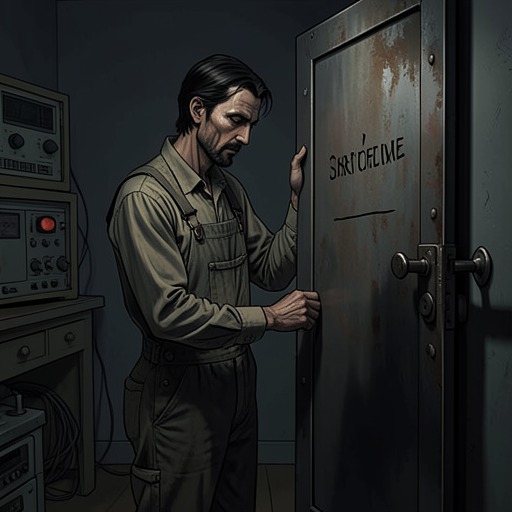
The current abruptly weakens. Confused by the change, Carl notices that Assad has raised his bound arms as far as he can and pressed the thumb encircled by the cable against the metal wall. A faint smell of burning flesh and a trace of smoke disclose what Assad is doing: the current is being diverted from the cable into the wall. Carl sees the thumb darkening, its nail turning brown, and understands that Assad is sacrificing it to create another route for the electricity. Remembering that current takes the shortest path to discharge, he asks Assad to press the cable directly against the wall. The intervention offers the men a chance to interrupt the circuit’s effect, but it does so by concentrating the injury in Assad’s hand.
Medical Consequences and Uncertain Recovery
When help arrived, Carl and Assad were found injured on the control-room floor, their feet tied with cables. Assad’s hand was severely burned, with his thumb blackened; Carl had injuries of his own, including a damaged ankle. A doctor treated Assad’s hand with a provisional dressing and bandaged Carl’s ankle, then sent both men to Kalmar Hospital for observation despite their apparently escaping life-threatening injuries. Assad’s thumb, however, was thought likely to require amputation. Carl could only respond to his partner’s sacrifice with gratitude, placing a hand on Assad’s shoulder and thanking him.
By Friday, May 16, and Saturday, May 17, the hospital’s assessment was unequivocal: Assad’s left thumb needed to be amputated. He refused, insisting that if it had to come off, he would do it himself. Carl found the prospect sickening. Later, Assad tried treating the blackened thumb with tea tree oil, which he said Rose had taught him to use as a disinfectant. Carl warned that the injury looked like a third-degree burn and that the nerves were dead, so the oil could not help. Assad countered that he could still feel life in the thumb and believed the damage might be limited to the skin and the top joint. The episode ends without resolving whether the thumb could be saved: its appearance and the medical prognosis point toward amputation, while Assad holds to the bodily sensation that it remains alive.
The Injury as an Improvised Exit
The injury’s larger significance lies in the reversal built into the circuit: a system arranged to make the men’s bodies conduits for punishment is disrupted when Assad uses his own injured hand to redirect the current. The solar equipment turns changing daylight into an unstable measure of danger, while the metal wall offers a way to alter the current’s path. In that reversal, the thumb becomes more than the site of damage; it is the point at which the apparatus can be resisted. Yet the escape does not produce a clean resolution. The hospital’s prognosis and Assad’s refusal to accept it leave the injury suspended between medical judgment and his own insistence that life remains in the thumb.